“Which CEE market should we enter first?” sounds like a geography question. In practice, it is a learning question. The right first market depends on what the company needs to prove: scale, digital fit, channel economics, partner capability, consumer response or the repeatability of its European operating model.
Poland, Czechia and Romania can all be credible starting points, but they test different capabilities. Smaller markets can also be strategically useful when the category, partner set-up or existing account relationships make them efficient.
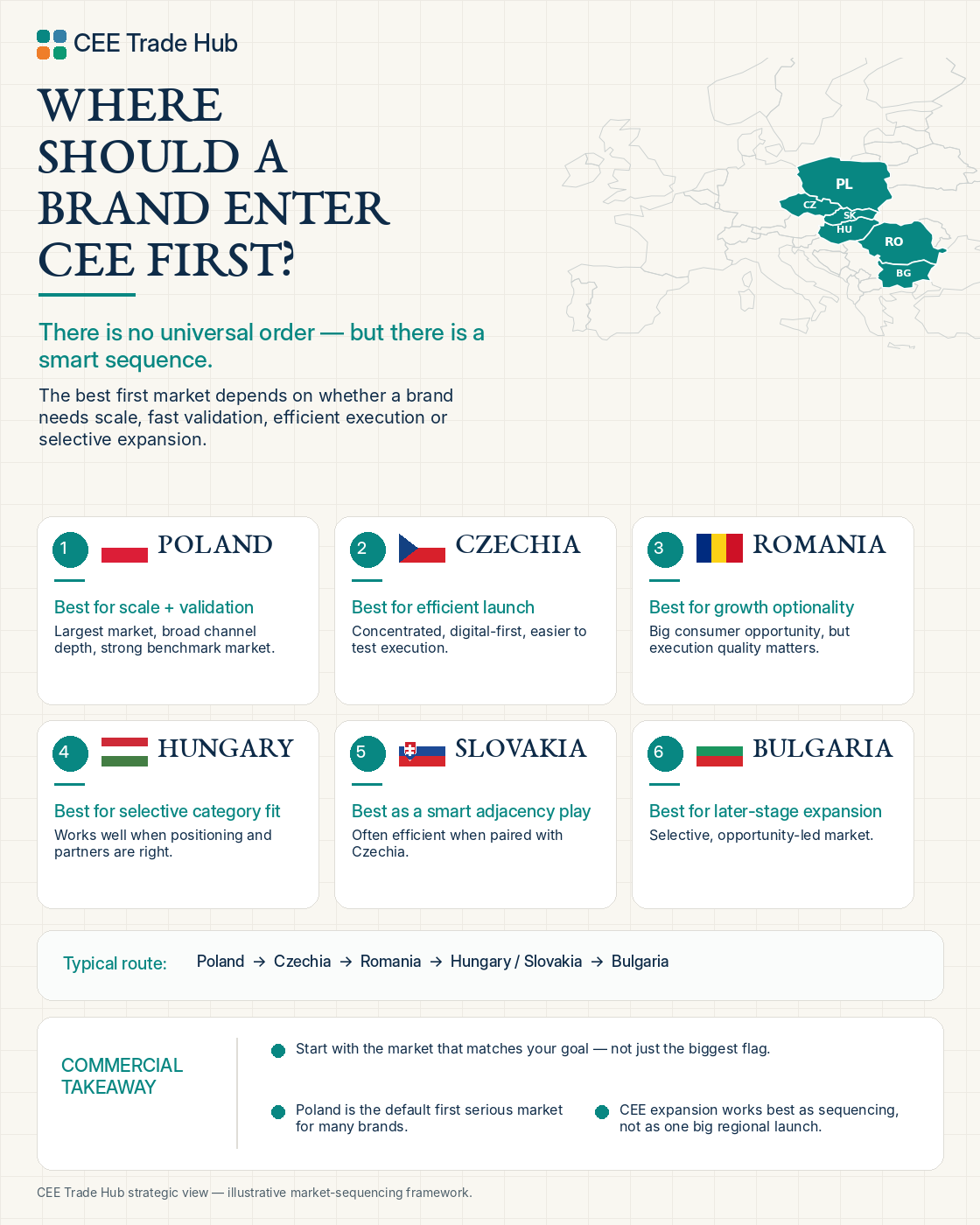
n
Start with the commercial hypothesis
Market size is easy to compare. Execution quality is harder. A first market should generate evidence that improves the second decision, not simply produce the first purchase order.
Before choosing the country, define the question the launch must answer. Is the company testing whether consumers accept the proposition? Whether a large retailer can scale it? Whether marketplace demand exists? Whether a distributor can build a category? Or whether the internal organisation can support local content, pricing, stock and service?
Poland: best for scale + validation
Poland is the default serious CEE test for many consumer categories because it combines market scale with omnichannel pressure. It is useful when the brand wants to validate pricing, account economics, marketplace visibility and the ability to manage several channels at once.
The downside is that Poland can expose weak preparation quickly. Broad availability without price governance can damage future retailer conversations. A large distributor relationship is not enough if the partner cannot open the right national accounts or support sell-out.
Czechia: best for efficient launch learning
Czechia is smaller, but its concentrated and highly digital market structure can make commercial learning fast. For technology-led and e-commerce-heavy categories, specialist platforms and strong online research behaviour create a useful environment for product education and focused account execution.
That does not make Czechia “easy”. It makes the market efficient when the proposition fits digital buying behaviour and the brand can execute locally.
Romania: best for growth optionality
Romania offers meaningful scale and a strong role for local champions in both retail and e-commerce. It is particularly valuable when the expansion thesis includes South-Eastern Europe or when the brand wants to learn how a large local platform ecosystem behaves.
The risk is treating Romania as a simple extension of a Central European model. Channel roles, partner capability, pricing and operational expectations need separate validation.
Hungary: selective category fit
Hungary can work well when the category has clear local retail relevance and the brand has the right partner or direct account route. It is less attractive as an automatic regional checkbox. The commercial case should be built around specific accounts, category economics and execution resources.
Slovakia: a smart adjacency play
Slovakia often benefits from adjacency to Czechia, but operational accountability still needs to stay explicit. Shared language capabilities, logistics or commercial structures can improve efficiency; they should not become an excuse for weak local ownership.
Bulgaria: selective later-stage expansion
Bulgaria can be attractive for brands with a strong regional operating model and identified local opportunities. For many new entrants, however, it is more efficient to build the playbook in a larger or more concentrated market first and then expand selectively.
A practical sequencing framework
For a broad consumer brand without existing regional anchors, a common logic can look like:
Poland → Czechia → Romania → Hungary / Slovakia → Bulgaria
This is not a universal ranking. A company with a strong Romanian retailer relationship may reasonably start there. A digital specialist may prefer Czechia. A brand with an existing distributor in Hungary may have a lower-cost first test there. The purpose of sequencing is to match the market to the question.
Three rules before committing
- Do not let the first inbound distributor choose the strategy. Decide what the market must prove before granting territory or exclusivity.
- Separate market potential from execution readiness. A large market can be a bad first step if the organisation cannot support it.
- Measure transferability. The best first market improves the playbook for the next one.
Commercial takeaway: CEE expansion works best as sequencing, not as one big regional launch.
How sequencing changes by category
The order above is deliberately generic. Category economics can change it substantially. A smart-home brand with strong specialist e-commerce content may learn faster in Czechia. A DIY or power-tools brand may prioritise Poland and Romania because large home-improvement chains create more relevant account tests. A value-led consumer-electronics brand may prefer a market where one or two digital platforms can generate fast price and demand feedback.
The correct sequence is therefore a function of category × price point × channel model × organisational readiness. Headquarters should resist the temptation to turn one successful regional launch order into a permanent template.
What should be standardised regionally
Some parts of the model should absolutely be coordinated across CEE: recommended price logic, minimum margin expectations, product architecture, distributor reporting standards, brand assets, warranty principles and the conditions under which a partner receives additional rights.
Other elements should remain local: priority retailers, promotional timing, content nuance, local service expectations, marketplace dynamics and the specific partner network required to reach the category.
Evidence before expansion
Before opening the second or third country, the first market should have answered at least five questions: Which SKUs deserve investment? Which channels generate quality demand? What consumer price is sustainable? What partner capabilities are genuinely scarce? And what internal support is required every week rather than only at launch?
If those answers are still unclear, expanding geography usually multiplies ambiguity rather than growth.
Sequence by learning value, not only revenue potential
A first market should earn the right to unlock the second. That means the launch needs explicit learning objectives and a review point. If Poland proves the price architecture but exposes service weakness, fix service before adding another country. If Czechia validates product education and e-commerce conversion, use that evidence to improve the next launch. If Romania proves a local-partner model, identify which partner capabilities are genuinely transferable.
This discipline prevents a common regional-expansion pattern: six countries open, six different distributors appointed, and no market developed deeply enough to explain what is actually working.
A useful decision rule for headquarters
Choose the first market where commercial relevance × execution readiness × learning value is highest. Then sequence the next country only when the first launch has produced evidence on product, pricing, channel economics and operating requirements. Market sequencing is therefore not a fixed ranking. It is a management system for reducing uncertainty as geography expands.
Related reading
- Poland Market Report 2026
- Czechia market analysis
- Romania market analysis
- When Germany should not be your first European market
How this analysis was prepared
This article is an editorial analysis based on practical market-development experience and observation of public channel structures. It does not disclose confidential employer, retailer, distributor or client information. Market conditions and listings should be rechecked before a commercial decision.

Founder of CEE Trade Hub. International sales and market-development executive with more than a decade of experience across consumer technology, smart home, retail, distribution and European markets.
LinkedIn profile →