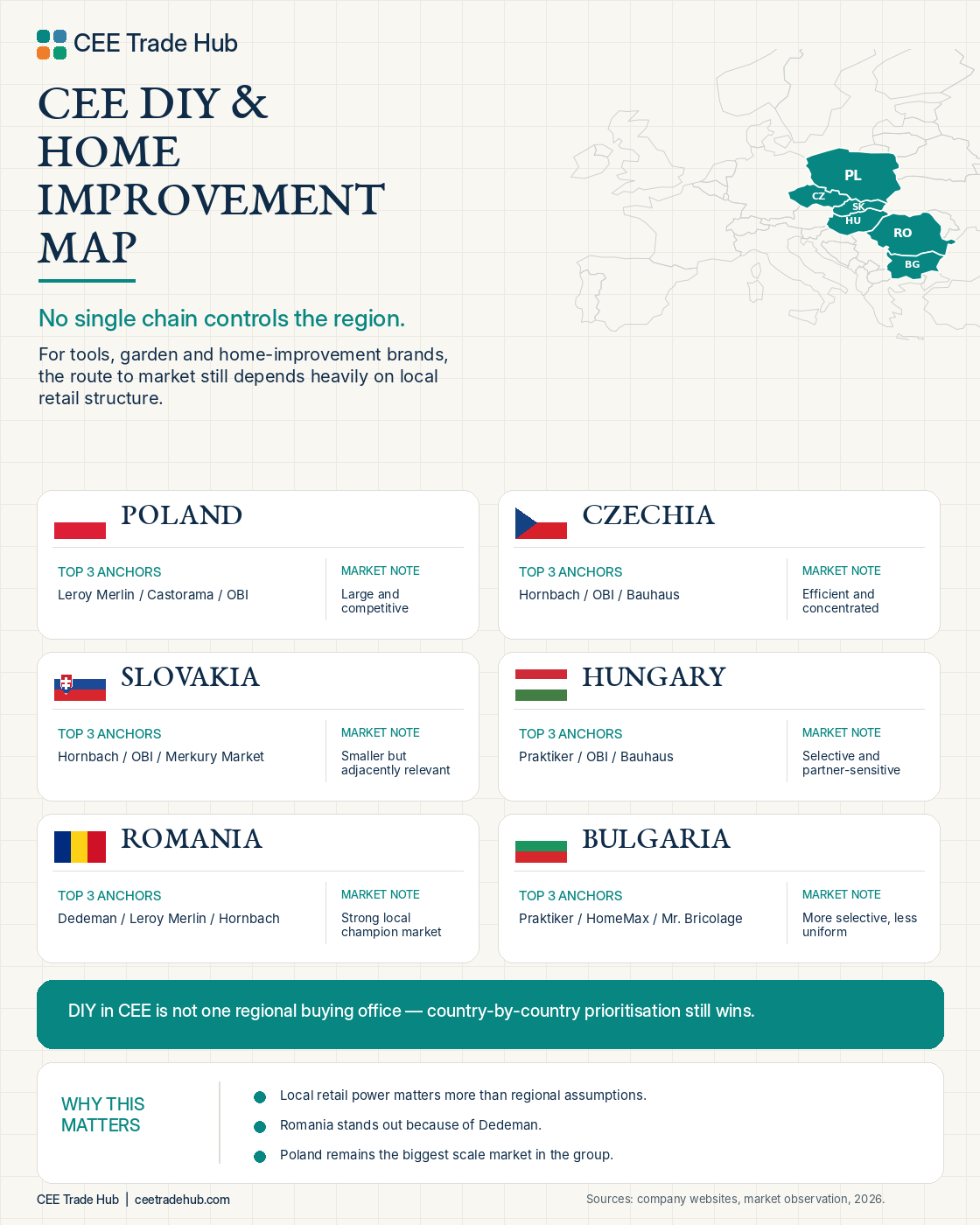
DIY and home-improvement retail in CEE is a good example of why “regional coverage” can be misleading. Several international chains operate across multiple countries, but the balance of power changes market by market. Local champions can be decisive, and the best route for power tools, garden, home-improvement and project-driven categories often depends on category fit rather than raw store count.
n
Poland: large and competitive
Leroy Merlin, Castorama and OBI are major reference chains for many DIY and home-improvement categories. Poland’s scale creates opportunity, but also competition for range space and promotional attention.
For a new brand, winning a listing is not enough. The proposition needs a clear price ladder, local content, stock reliability, promotional support and an answer to how online marketplace pricing will coexist with retail.
Czechia: efficient and concentrated
Hornbach, OBI and Bauhaus are central reference points. The market can be efficient for brands with a clear proposition because the priority-account universe is relatively concentrated.
The commercial question is not how many partners a brand can sign. It is whether the chosen route can open and develop the few accounts that shape the category.
Slovakia: a smaller adjacency market
Hornbach, OBI and Merkury Market illustrate the mix of international and regional formats. Slovakia can benefit from a Czech-Slovak operating model, but local assortment, pricing and commercial ownership should still be explicit.
Hungary: selective and partner-sensitive
Praktiker, OBI and Bauhaus are among the relevant chains. The market often rewards selective execution. A capable local partner can be valuable, but only when account access, category capability and commercial investment are demonstrable.
Romania: the local-champion effect
Romania is structurally important because of Dedeman. Alongside Leroy Merlin and Hornbach, it creates a market where local retail power matters heavily.
For suppliers, this means a pan-European account strategy is not enough. The Romanian plan needs to acknowledge local buying power, assortment expectations and operational requirements.
Bulgaria: more selective, less uniform
Praktiker, HomeMax and Mr. Bricolage are among the retail names brands may need to evaluate. The smaller addressable market increases the importance of category fit and cost-to-serve.
Three implications for suppliers
1. Local retail power matters more than regional assumptions
Two markets that share the same international chain can still require different assortment, buyer relationships, margins and promotional support.
2. Distributor value should be measured account by account
A partner’s territory coverage is less important than its ability to access and develop the actual chains that matter for the category.
3. Pricing architecture must survive omnichannel reality
DIY and tool brands increasingly face overlap between specialist retail, marketplaces and general e-commerce. If the price ladder only works in one channel, the regional model is fragile.
Commercial takeaway: DIY in CEE is not one regional buying office — country-by-country prioritisation still wins.
Why DIY needs a different launch logic
DIY and home-improvement categories are often more operationally demanding than small consumer electronics. Packaging size, in-store presentation, seasonal demand, demo requirements, spare parts, warranty handling and assortment logic can all affect whether a listing becomes productive. A distributor that is excellent in pure e-commerce may not be the right partner for project retail or garden categories.
Local champions change negotiation power
Romania is the clearest example, but the principle applies across the region. When a local chain has strong category authority, a supplier cannot rely only on a pan-European relationship with an international group. The local account needs a proposition built around its shoppers, assortment architecture and promotional model.
Assortment architecture before account expansion
Brands should decide which products are hero SKUs, which create ecosystem entry, which can sustain normal margin and which justify a specialist premium. Without that architecture, regional expansion often creates inconsistent ranges and promotions from country to country.
For battery-platform tools and garden systems, this is especially important because the economics of the first tool, starter kit, battery and later ecosystem expansion are connected.
What a distributor must prove in DIY
- named access to the category buyers that matter;
- experience with planograms, listings and seasonal reviews;
- local field or merchandising capability where needed;
- returns, warranty and spare-parts processes;
- ability to report sell-out and stock, not only purchase orders;
- budget and people for launch support.
What changes when the product needs physical retail
For many DIY, garden and power-tool categories, the economics of market entry depend on more than online conversion. Shelf space, seasonal range reviews, demonstration, batteries and accessories, service, spare parts and local merchandising can all influence sell-out. That makes the quality of the retailer relationship and the partner’s field capability especially important.
A practical launch plan should therefore separate listing readiness from sell-out readiness. A SKU can be technically listed while the range architecture, display, content, service or replenishment model is still too weak to generate sustainable demand.
Use retailer concentration to focus investment
In more concentrated markets, brands can often learn faster by investing deeply in two or three relevant chains instead of spreading budget across many accounts. In larger markets such as Poland and Romania, the same principle still applies: identify the retailers that matter most for the category and fund the execution required to make those relationships productive.
Selected company sources
- Leroy Merlin Poland · Castorama Poland · OBI Poland
- Hornbach Czechia · OBI Czechia · Bauhaus Czechia
- Dedeman Romania · Leroy Merlin Romania · Hornbach Romania
Retailer relevance varies by category, region and project type. Account priorities should be refreshed before commercial commitments.
How this analysis was prepared
This article is an editorial analysis based on practical market-development experience and observation of public channel structures. It does not disclose confidential employer, retailer, distributor or client information. Market conditions and listings should be rechecked before a commercial decision.

Founder of CEE Trade Hub. International sales and market-development executive with more than a decade of experience across consumer technology, smart home, retail, distribution and European markets.
LinkedIn profile →