Consumer-electronics retail in CEE looks regional from headquarters and local from the buyer meeting. International chains matter, but the practical access points, specialist platforms and price-setting mechanisms differ sharply by country.
That is why a regional account list is not the same thing as a regional route-to-market strategy.
n
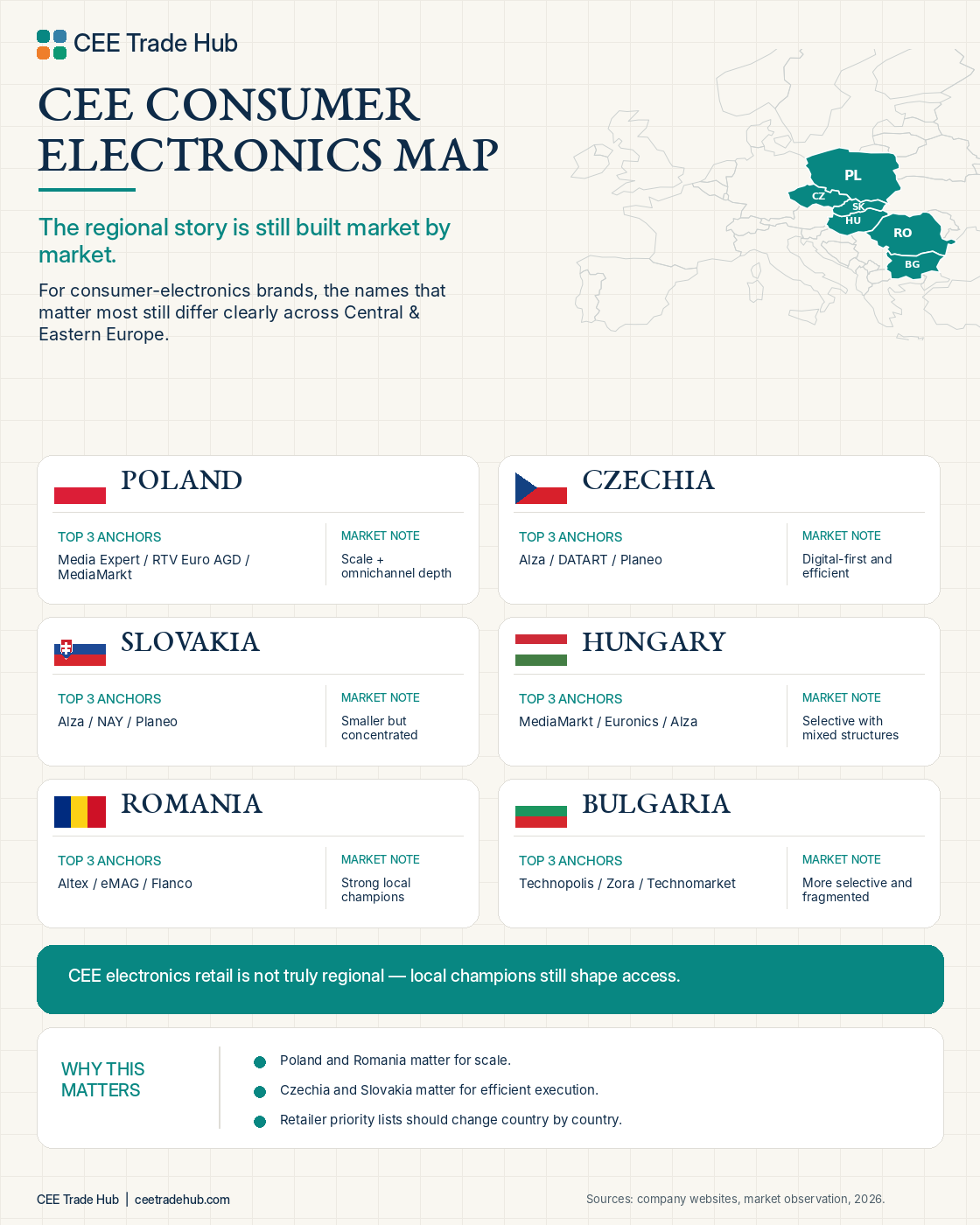
Poland: scale + omnichannel depth
For many consumer-electronics categories, Media Expert, RTV Euro AGD and MediaMarkt are core reference accounts. Poland also has very high online price transparency, with Allegro and comparison behaviour influencing how a new brand is perceived before national retail distribution is fully built.
The practical challenge is coordination: retailer pricing, marketplace visibility, content quality, stock and promotions need to reinforce rather than undermine one another.
Czechia: digital-first and efficient
Alza plays an outsized role in Czech consumer electronics, supported by other important players including DATART and Planeo. For technology-led products, this can create a concentrated environment where product education, reviews, availability and digital merchandising matter as much as physical store count.
The opportunity is speed of learning. The risk is assuming that a successful online listing equals full market development.
Slovakia: smaller but concentrated
Slovakia often shares commercial logic with Czechia, but local accountability is still required. Alza, NAY and Planeo are among the relevant anchors depending on category.
A cross-border operating model can be efficient, provided someone still owns Slovak pricing, content, inventory and account follow-up.
Hungary: selective with mixed structures
MediaMarkt, Euronics and Alza illustrate the mix of international, local and digital structures in Hungary. The market often rewards focus more than broad account coverage.
Before expanding distribution, brands should be clear about which accounts can actually build the category and how local pricing will coexist with cross-border online offers.
Romania: strong local champions
Altex, eMAG and Flanco are important examples of why Romania cannot be managed as a simple extension of a Central European retail plan. Local players have substantial consumer relevance and the role of eMAG gives the market a distinctive marketplace and e-commerce dynamic.
Romania can offer meaningful scale, but execution quality — local content, fulfilment, pricing and commercial ownership — becomes critical.
Bulgaria: more selective and fragmented
Technopolis, Zora and Technomarket are among the names an international brand may need to understand. The market is generally smaller and more selective, making account prioritisation and partner capability especially important.
What this means for brands
- Retail access is local. A regional distributor is useful only if it can reach the specific accounts that matter.
- Online visibility sets expectations early. Poor marketplace governance can weaken later retailer negotiations.
- One merchandising playbook will not fit every market. Product education, promotions and content need local adjustment.
- Account concentration can be an advantage. In smaller markets, a few well-executed relationships can be more valuable than broad nominal distribution.
Commercial takeaway: CEE electronics retail is not truly regional — local champions still shape access.
Why the same retailer name can mean a different job
Even when the same international retailer operates in several countries, its commercial role can differ. In one market it may be the premium physical reference. In another it may be mainly a price-checking destination. Elsewhere a local specialist or marketplace can dominate product discovery. International account agreements therefore need local interpretation.
The platform problem: reach versus control
Marketplaces can create immediate reach, but they also make price architecture public. If the brand has not defined seller permissions, recommended price logic, promotional boundaries and stock ownership, early marketplace growth can weaken the next strategic retailer negotiation.
This is especially important in CEE because consumers frequently compare across local platforms and, in some categories, across borders. The retail plan and the marketplace plan should be designed together.
A practical account-priority test
Before adding a retailer to the launch list, ask four questions: Does this account reach the right consumer? Can it explain the product properly? Does it strengthen or weaken price architecture? And can the brand support the account operationally? A famous logo with weak category fit can be less valuable than a specialist platform that creates informed demand.
What to measure after listing
- sell-out rather than only initial sell-in;
- share of priority SKUs with complete local content;
- price dispersion across authorised sellers;
- availability and lost-sales periods;
- review volume and recurring product questions;
- promotion quality and post-promotion price recovery.
How to turn the map into an account plan
The visual should be treated as the start of the discussion, not a definitive retailer ranking. For each country, the commercial team should build a category-specific account matrix with four roles: brand builder, volume account, digital discovery platform and price reference. Some retailers will occupy more than one role; others may be strategically irrelevant for a specific category despite their national scale.
That matrix should then drive launch sequencing. The first wave should contain only the accounts the organisation can support with local content, stock, pricing and service. Adding distribution before the first wave is stable normally increases price noise and operational complexity.
Regional agreements still need local commercial ownership
Central negotiations can improve terms and reduce duplication, but they do not replace local execution. A retailer present in several countries may have different category strength, buyer structures and promotional calendars in each market. The account owner should therefore translate the regional relationship into a local commercial plan rather than assume that one listing decision creates the same market effect everywhere.
Selected company sources
- Media Expert · RTV Euro AGD · MediaMarkt Poland
- Alza Czechia · DATART · Planeo Czechia
- Altex · eMAG Romania · Flanco
Retailer relevance varies by category and should be refreshed before a live market-entry project.
How this analysis was prepared
This article is an editorial analysis based on practical market-development experience and observation of public channel structures. It does not disclose confidential employer, retailer, distributor or client information. Market conditions and listings should be rechecked before a commercial decision.

Founder of CEE Trade Hub. International sales and market-development executive with more than a decade of experience across consumer technology, smart home, retail, distribution and European markets.
LinkedIn profile →