Romania is one of the most strategically interesting consumer markets in CEE because it combines meaningful scale with a channel structure that cannot simply be copied from Central Europe. Local retail champions, the role of eMAG and different operational expectations make Romania both an opportunity and an execution test.
n
Executive summary
- Market role: large South-Eastern European consumer opportunity.
- Channel structure: strong local retail and marketplace power.
- Commercial advantage: scale and a distinct digital ecosystem can generate valuable regional learning.
- Main risk: assuming that a Polish, Czech or DACH route-to-market model transfers unchanged.
Why Romania matters
Romania has enough consumer scale to matter in a regional expansion plan, but its real strategic value comes from difference. A brand that succeeds here learns how to operate in a market where local champions are highly relevant and where platform dynamics can shape pricing, reach and product discovery.
This is particularly important for consumer electronics, home, smart home, appliances and adjacent categories. The right partners and accounts can create significant reach; the wrong operating model can leave the brand visible online but commercially fragmented.
Retail and e-commerce structure
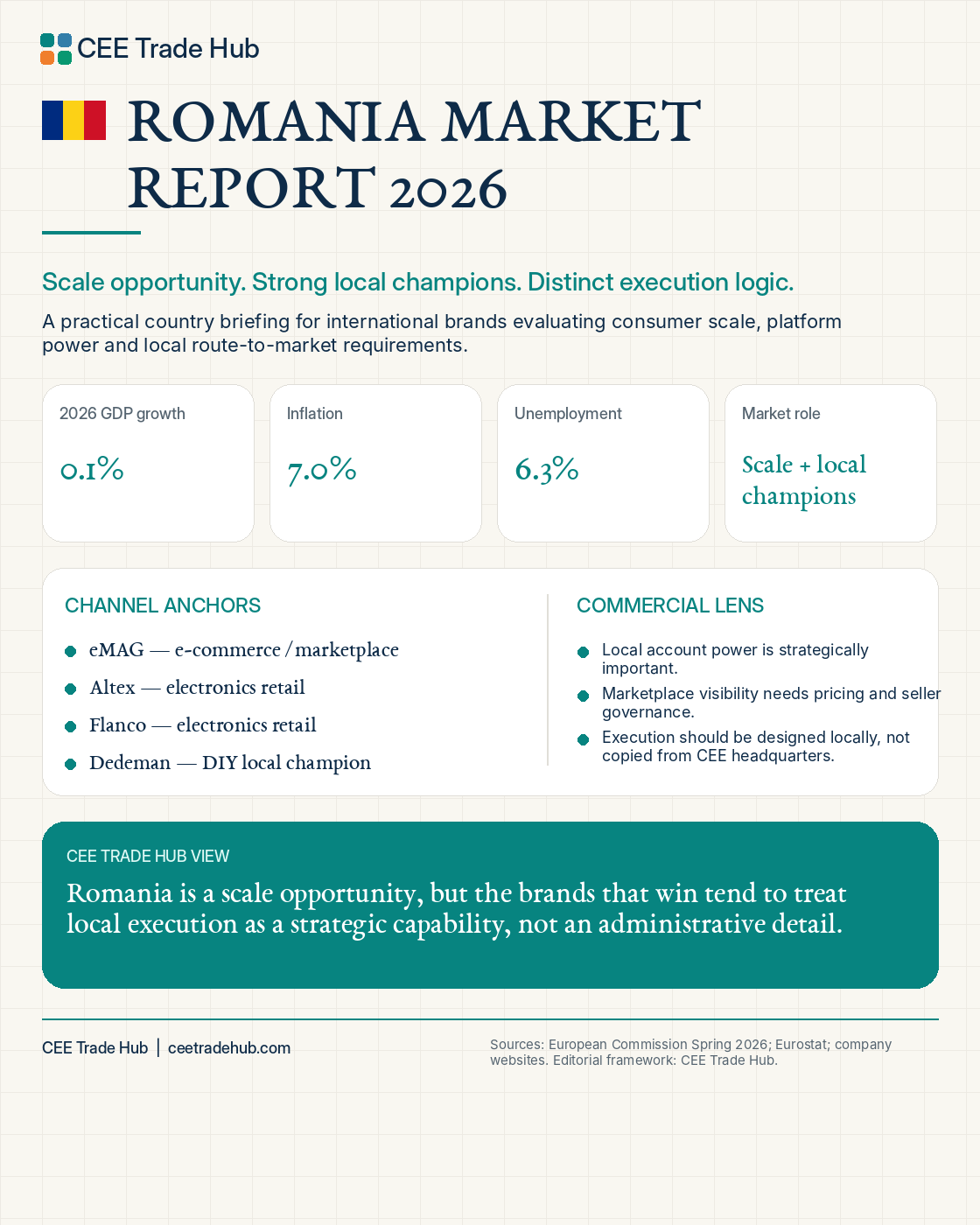
eMAG is a central reference point in Romanian e-commerce and marketplace activity. Altex and Flanco are important consumer-electronics anchors. In DIY and home improvement, Dedeman is a powerful local champion alongside international chains including Leroy Merlin and Hornbach.
These examples show why regional headquarters should not measure Romanian coverage only by whether an international chain is present. Local account power is fundamental.
What makes execution different
Local account relevance
International retailer relationships can help, but they do not replace local buyer access and local commercial ownership.
Marketplace visibility
Online availability can accelerate discovery, but uncontrolled marketplace sellers may establish a public price before the brand has built the wider channel model.
Partner capability
A distributor should be evaluated on its ability to open and develop the named accounts the category requires. Warehouse size and territory claims are weak substitutes for evidence.
Operational discipline
Local content, stock, returns, service and promotional execution need explicit ownership. A brand cannot assume that regional management alone will solve these details.
Route-to-market options
Distributor-led
Can be effective when the distributor has real retailer access, category expertise and the resources to support sell-out. Exclusivity should be linked to demonstrated capability and performance milestones.
Direct key accounts
Attractive for brands with enough scale and internal resources to manage local commercial and operational requirements. Direct retail should not be confused with remote account management.
Marketplace-led validation
Useful for learning and demand signals, but it should be governed. Seller permissions, pricing, content and inventory need rules from the beginning.
Common mistakes
- Assuming Romania is “the same playbook, further east”.
- Overvaluing regional distributor claims without account-level proof.
- Letting marketplace prices develop before retailer strategy is clear.
- Underinvesting in local content and operational support.
- Using a broad country launch before the priority-account logic is proven.
The first 90 days
Days 1–30: map the real market
- Define the category-specific account universe.
- Benchmark eMAG, local retailers and visible price architecture.
- Identify service, fulfilment and localisation requirements.
Days 31–60: compare execution models
- Meet priority retailers and credible distributors.
- Test partner account access with named evidence.
- Build the P&L backwards from local consumer price.
Days 61–90: choose the narrowest credible launch
- Prioritise the channels that will create useful learning.
- Set sell-out, content and inventory KPIs.
- Expand only after the operating model is working.
CEE Trade Hub view: Romania is a scale opportunity, but the brands that win are usually the ones that treat local execution as a strategic capability rather than an administrative detail.
Consumer scale is not the same as easy access
Romania’s size makes it attractive, but the quality of access matters. A brand can achieve broad online visibility and still fail to build durable retail credibility. The commercial model should distinguish between traffic, transaction and strategic account development.
This is especially relevant when the product needs explanation, installation, service or a physical demonstration. Marketplace demand may be useful, but it cannot automatically replace retailer education or local support.
Price architecture and marketplace governance
eMAG’s importance means marketplace strategy should be designed before the launch, not added later. The brand needs rules for authorised sellers, content, stock ownership, promotions and the relationship between marketplace prices and strategic retail accounts.
The objective is not to eliminate online price competition. It is to prevent avoidable channel conflict from becoming the dominant market signal before the brand has built a controlled proposition.
Why local champions matter strategically
Altex, Dedeman and other strong local players show that Romania cannot be understood only through the lens of international chains. For international headquarters, local champions are important for two reasons: they can unlock meaningful demand, and they reveal how different the local buying logic may be from other CEE markets.
Distributor due diligence in Romania
A distributor should be tested against a named account plan. Which retailers can it open? Who are the buyers? What categories does it actively develop? How will it finance stock? Who manages marketplace sellers? What service capability exists? How often will the brand receive sell-out and stock reporting?
Broad claims such as “national coverage” or “exclusive distributor” should be treated as hypotheses until supported by evidence.
Category implications
Consumer electronics: local retailer and platform power make digital content and price governance central.
DIY and tools: Dedeman materially changes the account map. Local retail relationships can matter more than regional buying assumptions.
Smart home and connected products: service, compatibility communication and local-language education can determine whether online traffic converts into sustainable demand.
Management questions before launch
- Which local accounts are genuinely indispensable for this category?
- What role should eMAG play: validation, scale, marketplace reach or all three?
- Can the chosen partner support service and local content as well as sell-in?
- How will consumer pricing be governed across authorised sellers?
- What evidence must exist before expanding assortment or territory rights?
2026 data snapshot: a weak macro year does not remove the strategic case
The European Commission’s Spring 2026 forecast expects Romanian real GDP growth of 0.1% in 2026, after 0.7% in 2025, before a projected rebound to 2.3% in 2027. It forecasts HICP inflation of 7.0% and unemployment of 6.3% in 2026. Fiscal consolidation and high inflation are expected to weigh on consumption in the near term, while EU-funded investment remains supportive.
For market-entry planning, that makes 2026 a year in which execution quality matters even more. A slower macro environment does not make Romania irrelevant. It makes broad, undisciplined distribution less attractive. Brands should be clearer about price points, account priorities, stock exposure and the role of each channel in the first phase.
Romania is a local-champion market, not just a regional extension
One of the most important commercial lessons in Romania is that international headquarters cannot understand the market only through pan-European chains. Local players are structurally important. In consumer electronics, eMAG, Altex and Flanco help shape discovery, traffic, retail credibility and price visibility. In DIY, Dedeman materially changes the account map.
That means the correct route to market often starts with a category-specific account map rather than a distributor map. Which local accounts are indispensable? Which channels create trust? Which create reach? Which create price transparency? Which require installation, service or in-store support?
Only after those questions are answered should the company decide whether direct key-account management, a distributor or a hybrid model is the best route.
eMAG: platform strategy needs to be designed, not improvised
For many categories, eMAG can be a powerful source of reach and demand signals. It can also become the place where uncontrolled marketplace activity defines the public price before the brand has built a wider channel strategy.
A strong launch therefore decides in advance what role eMAG should play. Is it the primary e-commerce account? A marketplace validation environment? A scale channel after retail credibility is established? The answer can differ by category, but the governance should be explicit.
Management should define authorised sellers, content ownership, inventory responsibility, promotional rules and the relationship between marketplace prices and strategic retail accounts. The objective is not to freeze the market. It is to avoid accidental channel conflict becoming the launch strategy.
Retail access: distinguish visibility from strategic distribution
Romania can create an illusion of rapid coverage because online availability is relatively easy to observe. But being searchable is not the same as building durable distribution. For products that require explanation, service, installation or physical demonstration, the quality of account execution is more important than the number of websites carrying the SKU.
A brand should therefore separate three layers of distribution:
- Discovery: where consumers first see and compare the product;
- Transaction: where volume can be generated efficiently;
- Strategic retail: where the brand gains category credibility, merchandising support and longer-term account development.
The same account can play more than one role, but the distinction helps management understand whether a new listing actually improves the market position.
Distributor selection: test the account plan before granting the territory
Romania is a market where a capable local distributor can add real value. It is also a market where broad claims such as “national coverage” should be challenged with evidence. The distributor should be able to show named category buyers, recent comparable launches, expected account-opening sequence, stock financing, service capability, local marketing resources and sell-out reporting.
If a partner requests exclusivity, the rights should be connected to measurable milestones. Examples include opening specified accounts, maintaining agreed stock, delivering product training, meeting sell-out targets and providing reporting at a defined frequency.
This protects both sides. The distributor receives a clear opportunity to build the market; the brand avoids locking the territory before capability has been proven.
Price architecture in a higher-inflation environment
With the Commission forecasting 7.0% inflation for 2026, price architecture deserves more attention than a simple euro-to-lei conversion. The local model should allow for currency movements, retailer margin, distributor margin where applicable, promotional funding, logistics, returns and warranty cost.
Brands that enter with a consumer price decided centrally and then try to “fit” partner economics underneath it often create immediate tension. A better approach is to model the P&L backwards from realistic local consumer price points and identify the minimum conditions under which the channel remains sustainable.
Category-specific implications
Consumer electronics: digital content, eMAG governance, local retailer relationships and price discipline are central. A product with weak local content can become commoditised quickly.
DIY and power tools: Dedeman’s local strength means regional buying assumptions can be misleading. The account map should be built specifically for Romania, including service and seasonal execution requirements.
Smart home and connected devices: compatibility communication, installation expectations, warranty and local-language support can materially affect conversion and reviews.
Small appliances and lifestyle products: promotional intensity can create volume, but the brand should distinguish sustainable price architecture from one-off campaign success.
What a good first six months should prove
The first phase should leave management with evidence rather than just orders. A strong Romanian launch should answer:
- Which two or three channels create the best quality demand?
- Which price points convert without destroying channel economics?
- Does the chosen partner actually open and develop the priority accounts?
- What service and content workload is required locally?
- Which SKUs deserve broader distribution and which should remain focused?
- Can marketplace visibility coexist with strategic retail without avoidable conflict?
If the company cannot answer those questions, expansion of assortment or territory is premature.
Final management view
Romania should not be dismissed because 2026 macro growth is weak, nor over-simplified because it is a large CEE consumer market. The opportunity sits in the combination of scale, strong local players and a distinct digital ecosystem.
Brands that win tend to build a Romanian operating model deliberately: local account priorities first, platform governance before uncontrolled volume, partner rights tied to evidence and price architecture built around real local economics. That is what turns market presence into a repeatable commercial position.
This report is a commercial market-entry briefing, not an investment recommendation. Retailer roles and channel priorities should be refreshed for the specific product category before execution.
Selected sources
- European Commission — Economic forecast for Romania, Spring 2026
- eMAG Romania
- Altex
- Flanco
- Dedeman
- Eurostat
Category data, market shares and account relevance should be refreshed before a live investment decision.
How this analysis was prepared
This article is an editorial analysis based on practical market-development experience and observation of public channel structures. It does not disclose confidential employer, retailer, distributor or client information. Market conditions and listings should be rechecked before a commercial decision.

Founder of CEE Trade Hub. International sales and market-development executive with more than a decade of experience across consumer technology, smart home, retail, distribution and European markets.
LinkedIn profile →