A scorecard cannot decide market entry. It can make the decision more disciplined. CEE expansion discussions often compare country size while leaving execution difficulty, digital maturity, retailer access and organisational readiness implicit. The result is a ranking that looks precise but does not explain what the company can actually execute.
The CEE Trade Hub Market Entry Scorecard is an editorial framework for structuring that discussion. It is intentionally simple and should be adapted by category.
n
The five dimensions
1. Commercial size
Addressable category demand, number and quality of priority accounts, realistic first-year volume and the ability to create a meaningful local reference.
2. Growth
Macro momentum matters, but category growth matters more. The score should reflect whether the addressable category is expanding, not only national GDP.
3. Digital maturity
How strongly consumers research online, the role of e-commerce specialists, marketplace penetration, price comparison and the quality of digital merchandising.
4. Retail access
How concentrated the important accounts are, how difficult buyer access is, whether distributors can credibly cover the right retailers and how much local support listing requires.
5. Execution ease
Language, content, stock, logistics, service, pricing, partner governance and the amount of local management needed before the model becomes repeatable.
Illustrative comparison
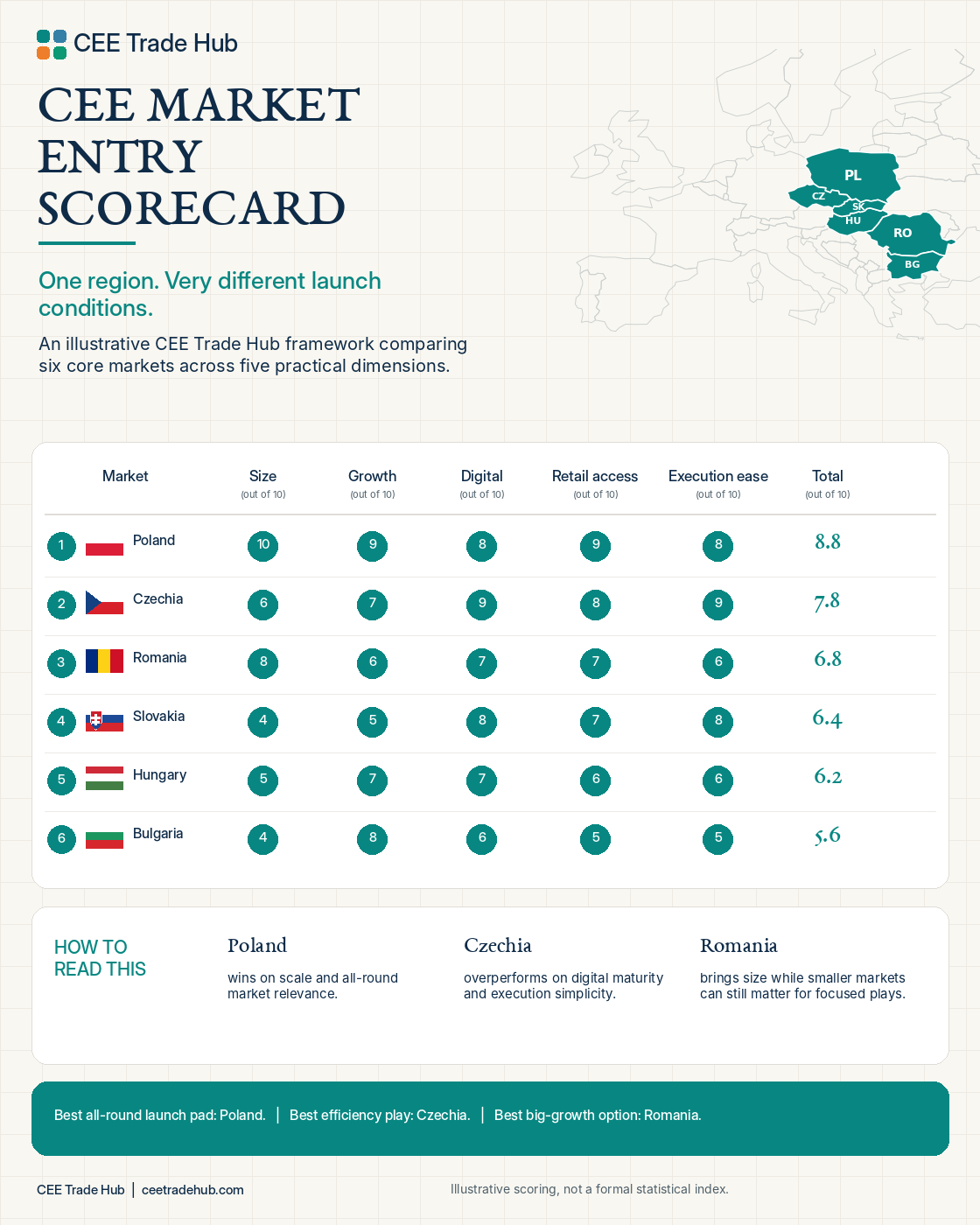
| Market | Size | Growth | Digital | Retail access | Execution | Illustrative total |
|---|---|---|---|---|---|---|
| Poland | 10 | 9 | 8 | 9 | 8 | 8.8 |
| Czechia | 6 | 7 | 9 | 8 | 9 | 7.8 |
| Romania | 8 | 6 | 7 | 7 | 6 | 6.8 |
| Slovakia | 4 | 5 | 8 | 7 | 8 | 6.4 |
| Hungary | 5 | 7 | 7 | 6 | 6 | 6.2 |
| Bulgaria | 4 | 8 | 6 | 5 | 5 | 5.6 |
These scores are an illustrative editorial framework, not an official index. A real project should rebuild them around the exact category, price point, channel model and company capabilities.
What the framework suggests
Poland wins on all-round relevance
Poland combines the strongest scale with enough retail and digital maturity to test the complete operating model. It is the most obvious all-round launch pad for many brands, but also one of the markets most likely to expose weak preparation.
Czechia overperforms on efficiency
Czechia scores above its size because digital maturity and concentrated account structures can make execution relatively efficient. It is particularly useful when the product requires strong online education or specialist retail.
Romania brings size with a different execution profile
Romania remains strategically important because of its consumer scale and local e-commerce ecosystem. The execution model is less transferable from Central Europe, so local validation becomes more important.
Smaller markets can still be high-quality moves
Slovakia, Hungary and Bulgaria should not be dismissed because of size. They can be attractive when the brand has strong category fit, a credible partner or an efficient adjacency model. The question is whether the incremental complexity is justified by the commercial opportunity.
How to use the scorecard in a real project
- Define the category and price segment.
- Weight the five dimensions according to the company’s objective.
- Replace general scores with verifiable evidence: named accounts, online demand signals, partner capabilities, margins and operating requirements.
- Run the scorecard before discussing exclusivity or broad inventory commitments.
- Refresh it after the first 90 days using actual market evidence.
Commercial takeaway: the scorecard is useful when it forces assumptions into the open. It is dangerous when the numbers are treated as a substitute for market evidence.
Weighting changes the answer
A scorecard becomes much more useful when management changes the weights deliberately. A premium technology brand may assign more weight to digital maturity and specialist retail. A bulky home-improvement product may care more about logistics, physical distribution and after-sales service. A company under strict working-capital constraints may rank execution ease and stock requirements above theoretical market size.
The same six countries can therefore produce a different order for two brands in the same industry. That is not a weakness of the framework; it is the point.
Add a readiness score for your own organisation
Market attractiveness is only half of the decision. Add a second score for internal readiness: local-language content, account-management bandwidth, inventory availability, warranty process, local legal/compliance readiness, pricing governance and management attention. A market can be attractive and still be a poor first move if the organisation is not ready to support it.
Use evidence, not confidence
In market-entry projects, subjective confidence often rises faster than evidence. A distributor says the product will be easy to place. A retailer likes the presentation. A marketplace listing generates some early orders. None of those signals is useless, but each needs to be converted into verifiable evidence: named account commitments, margin calculations, sell-out data, campaign performance and operational KPIs.
The scorecard should improve as evidence arrives. The number that matters most is not the opening score but how quickly assumptions are replaced by facts.
Why the scorecard deliberately avoids false precision
The numbers in this framework are not statistical estimates and should not be presented as an external ranking. They are a way to expose assumptions. A “9” for digital maturity or an “8” for retail access means little until the project team can explain the evidence behind it: retailer concentration, marketplace importance, local search behaviour, partner capability, logistics and the category’s own route-to-market constraints.
For that reason, the scorecard should be rebuilt for every serious project. The visual version is a discussion starter; the working version should contain evidence, source dates, confidence levels and a named owner for each assumption.
Build two scenarios, not one ranking
A useful management exercise is to run the scorecard twice. The first scenario asks, “Where is the market most attractive?” The second asks, “Where are we most ready to execute?” The gap between those two rankings is often more valuable than the ranking itself. A highly attractive market with low organisational readiness may require a partner, a narrower range or a later launch. A smaller market with strong readiness may be the better place to learn first.
How this analysis was prepared
This article is an editorial analysis based on practical market-development experience and observation of public channel structures. It does not disclose confidential employer, retailer, distributor or client information. Market conditions and listings should be rechecked before a commercial decision.

Founder of CEE Trade Hub. International sales and market-development executive with more than a decade of experience across consumer technology, smart home, retail, distribution and European markets.
LinkedIn profile →