Czechia is one of the most commercially efficient markets in Central and Eastern Europe. It does not offer Poland’s scale, but it combines high digital maturity, concentrated account structures, strong specialist e-commerce and a consumer base accustomed to online research and comparison.
For international brands, that can make Czechia an excellent validation market — particularly in technology, consumer electronics, smart home and categories where product education matters.
n
Executive summary
- Market role: efficient, digitally mature CEE test market.
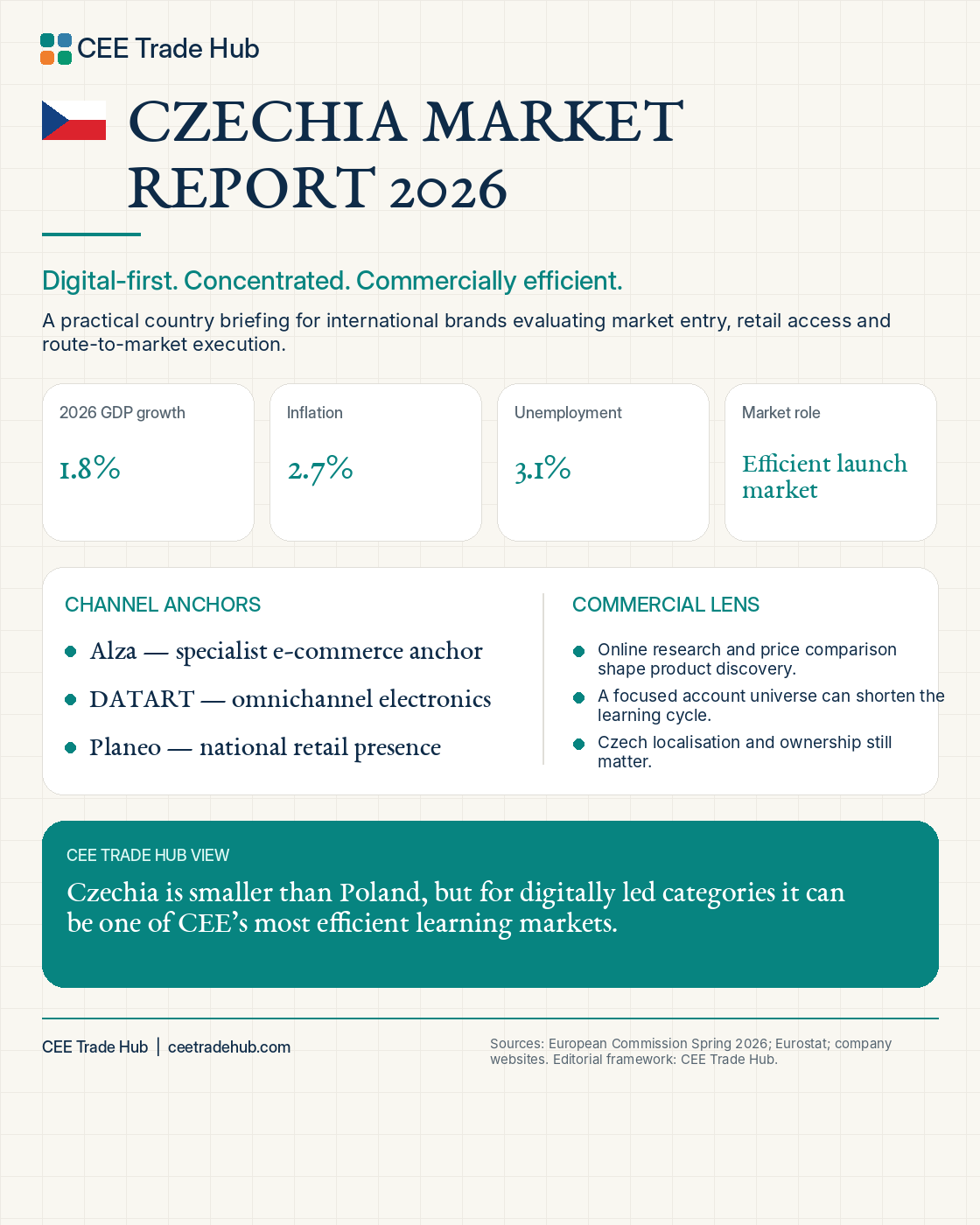
- 2026 macro: the European Commission forecasts real GDP growth of 1.8% in 2026 after 2.6% in 2025.
- Channel structure: relatively concentrated, with strong specialist and e-commerce players.
- Commercial advantage: a focused account universe can shorten the learning cycle.
- Main risk: mistaking digital availability for complete market development.
Macro context: stable, wealthy by regional standards, digitally mature
Czechia is a smaller economy than Poland, but household purchasing power, infrastructure, labour-market strength and digital adoption make it commercially attractive. The European Commission expects 2026 growth to slow to 1.8% amid energy-price and trade uncertainty before accelerating again in 2027.
For a commercial team, the more important structural point is that Czech consumers are highly accustomed to online research, specialist e-commerce and price comparison. This increases the value of good product content and fast digital execution.
Retail and e-commerce structure
Alza is one of the defining platforms in the Czech technology and consumer-electronics ecosystem. Its role goes beyond a simple online listing: for many categories it is a product-discovery, comparison and credibility environment.
Other important anchors include DATART and Planeo, while DIY and home-improvement categories are shaped by chains such as Hornbach, OBI and Bauhaus.
The commercial implication is concentration. A new brand can often identify a relatively small number of accounts that matter disproportionately. This is useful only if those accounts are executed properly.
Why Czechia can be a good first market
Fast product feedback
Strong online research behaviour means weak product positioning, content gaps and uncompetitive pricing become visible quickly.
Focused account learning
A smaller number of high-impact accounts can make it easier to test buyer response, product-market fit and merchandising without the organisational load of a much larger market.
Regional transferability
Czechia can generate useful learning for Slovakia and, depending on category, other Central European markets. Shared operational elements can create efficiency, but local ownership still matters.
Route-to-market choices
Direct retail
Works best when the brand can support local content, account management, supply, returns and promotional planning. Concentrated retail can make direct relationships attractive.
Distributor
A distributor can accelerate execution, especially when it has verifiable access to priority accounts and local category capability. Territory alone is not enough. Ask for named contacts, recent launches, sell-out processes and concrete investment plans.
Marketplace / e-commerce first
Useful for demand validation, but dangerous if pricing and seller governance are not defined. Early uncontrolled availability can make later retailer conversations harder.
Common mistakes
- Treating Czechia as a small afterthought to Germany or Poland.
- Assuming an Alza listing equals a complete market strategy.
- Using cross-border content without proper Czech localisation.
- Granting broad exclusivity before the partner proves priority-account access.
- Ignoring price-comparison behaviour and online price visibility.
The first 90 days
Days 1–30: validate the proposition
- Map the 5–10 accounts and platforms that actually matter.
- Benchmark consumer pricing and visible online competition.
- Localise product content and identify service requirements.
Days 31–60: test route to market
- Meet priority retailers and specialist platforms.
- Compare distributor proposals against a common scorecard.
- Model margins backwards from realistic consumer price.
Days 61–90: commit selectively
- Choose the account and partner model that produced evidence.
- Set measurable sell-out, content and promotional milestones.
- Avoid unnecessary territory rights before execution is proven.
CEE Trade Hub view: Czechia is smaller than Poland, but for digitally led categories it can be one of the region’s most efficient learning markets.
Consumer behaviour and the role of comparison
Czech consumers are comfortable researching products online before purchase. That raises the standard for localised specifications, comparison tables, reviews and availability information. A product page that might survive in a less transparent market can underperform when competing offers are one tab away.
For international teams, this means Czech localisation should be treated as commercial execution rather than translation. Titles, attributes, compatibility claims and product hierarchy need to match how local shoppers search and compare.
Pricing and channel governance
Price transparency can make the Czech market an excellent test of European pricing architecture. The brand should know the target consumer price, expected retailer margin, distributor margin where relevant, promotional room and the cost of fulfilment before broad distribution begins.
If authorised and unauthorised sellers appear at materially different prices, the issue becomes visible quickly. A launch plan should therefore define seller governance and marketplace rules at the same time as account expansion.
What good partner capability looks like
A credible Czech distributor should be able to show more than logos. Ask for the people who manage the target category, recent examples of opening comparable brands, named retailer relationships, marketing processes, stock reporting and a ninety-day launch plan. If the partner wants exclusivity, the rights should be linked to measurable account and sell-out milestones.
Czechia and Slovakia: where regional efficiency is real
Czechia and Slovakia are one of the places where shared resources can make genuine sense. Logistics, some commercial management and selected content processes can be coordinated. The efficiency disappears, however, if “shared” becomes “unowned”. Pricing, account responsibility and local execution still need named owners.
Category implications
Consumer electronics and smart home: specialist e-commerce and digital merchandising are particularly important. Product education can be decisive.
DIY and home improvement: concentrated chains make account prioritisation relatively clear, but in-store and service requirements can increase operational complexity.
Small appliances and lifestyle products: strong digital comparison rewards clear differentiation; generic features are easy to commoditise.
Management questions before launch
- What exact learning do we want Czechia to produce?
- Which three accounts would make the market strategically meaningful?
- Can our price architecture survive online comparison?
- Who owns Czech content, service and marketplace governance?
- If we use a distributor, what evidence justifies its territory rights?
2026 data snapshot: what the macro picture means commercially
The European Commission’s Spring 2026 forecast puts Czech real GDP growth at 1.8% in 2026, after 2.6% in 2025, with growth expected to re-accelerate to 2.4% in 2027. It forecasts HICP inflation at 2.7% and unemployment at 3.1% in 2026. For a market-entry team, the important point is not that these numbers make Czechia a high-growth market. They do not. The value of Czechia is the combination of relatively stable demand, a tight labour market, good infrastructure and a retail environment in which digital execution can be tested quickly.
That distinction matters. A market can be commercially attractive even when headline GDP growth is moderate. If the priority accounts are identifiable, shoppers research online, product information is visible and price comparison is easy, a brand can learn more from a focused Czech launch than from a broader but weakly managed regional roll-out.
The account universe: concentration is an advantage only when priorities are clear
In consumer electronics, a practical market map usually starts with a small number of high-impact names rather than a long retailer list. Alza, DATART and Planeo are useful examples because they represent different but complementary forms of market access: specialist e-commerce strength, omnichannel electronics retail and national retail coverage.
The point is not that every category requires the same three accounts. It is that Czechia often rewards disciplined prioritisation. A brand should define which accounts are required for credibility, which are required for volume, which are useful for product discovery, and which should be deliberately postponed until pricing, stock and content are stable.
This approach prevents the common mistake of measuring launch progress by the number of listings. Ten weak listings can create less market value than two well-managed strategic accounts with clean content, in-stock hero products and a controlled price architecture.
What a Czech launch should look like operationally
A good Czech launch is usually narrow before it becomes broad. The first range should be intentionally designed around products that can survive transparent comparison and explain the brand proposition quickly. Hero SKUs should have local-language content, clear specification tables, relevant compatibility information and a consumer price that supports the chosen channel economics.
Before expanding assortment, the commercial team should be able to answer four questions:
- Which SKUs are actually generating quality demand rather than only promotional traffic?
- Which accounts are building the brand rather than simply exposing price?
- What level of promotional depth is sustainable without damaging normal sell-out?
- What local operational work is required every week — content, stock, service, claims or marketplace governance?
If those answers are not yet clear, adding more accounts usually increases noise rather than learning.
Distribution versus direct retail: decide by capability, not habit
Czechia is concentrated enough that some international brands can justify direct management of key accounts. That can improve control over pricing, range, content and retailer relationships. But direct does not automatically mean better. If the internal organisation cannot support Czech-language content, replenishment, returns, local commercial planning and fast issue resolution, direct relationships can become administratively expensive and commercially weak.
A distributor can be the better model when it brings genuine buyer access, category knowledge and execution capacity. The decision should therefore be based on a capability gap analysis. What can the brand do itself? Which gaps are local and permanent? Which can be solved regionally? Which partner capabilities are difficult to build internally?
Exclusivity, where considered, should be a result of proven execution rather than the starting condition of cooperation. Account openings, launch timing, range coverage, sell-out reporting, marketing investment and service standards are more useful milestones than broad promises of territory coverage.
Marketplace and price architecture: design the rules before volume arrives
Czechia’s transparency is useful because it reveals weak price architecture early. It is also dangerous if the brand enters with too many sellers, unclear recommended pricing or inconsistent distributor terms. Once the market learns a low public reference price, repairing channel economics becomes difficult.
Before broad online distribution, management should agree on the relationship between consumer price, retailer margin, distributor margin where applicable, promotional budget, fulfilment cost and the level of marketplace participation the brand is prepared to accept. This does not mean trying to eliminate competition. It means making sure competition occurs inside an economically sustainable model.
What changes when Czechia is managed together with Slovakia
Czechia and Slovakia are a logical operational pair in many organisations. Shared logistics, some commercial resources and selected content processes can create real efficiency. But the countries should not disappear into one account spreadsheet. Priority retailers differ, local calendars differ, and accountability can become blurred when one team assumes that “CZ/SK” automatically means one execution model.
The strongest set-up keeps regional efficiencies while naming local ownership explicitly. A person or partner should still be accountable for Czech pricing, Czech content quality, account priorities, service issues and sell-out visibility. The same principle applies separately to Slovakia.
How to judge whether the first six months are working
Sell-in alone is a weak success measure. A Czech launch is much more convincing when the team can show:
- stable in-stock rates on the hero range;
- clean product content across the priority accounts;
- sell-out data or credible demand proxies, not only distributor purchases;
- price integrity within the intended promotional logic;
- evidence that the chosen retailer set reaches the right consumers;
- clear actions for the next assortment or channel expansion.
This is why Czechia can be an efficient learning market. The market is large enough to matter, concentrated enough to manage and transparent enough to expose weak assumptions quickly.
Final management view
Czechia should not be treated as a miniature Poland or a secondary extension of Germany. Its strategic value lies in a different combination: strong digital behaviour, concentrated account structures and a relatively efficient test environment for product, pricing and execution quality.
For brands that are prepared to localise properly and manage the market with discipline, Czechia can be one of the best places in CEE to prove whether a commercial model is ready for broader expansion.
Sources
- European Commission — Economic forecast for Czechia, Spring 2026
- Alza Czechia
- DATART
- Planeo Czechia
- Eurostat
How this analysis was prepared
This article is an editorial analysis based on practical market-development experience and observation of public channel structures. It does not disclose confidential employer, retailer, distributor or client information. Market conditions and listings should be rechecked before a commercial decision.

Founder of CEE Trade Hub. International sales and market-development executive with more than a decade of experience across consumer technology, smart home, retail, distribution and European markets.
LinkedIn profile →