Poland is often introduced as the largest market in Central and Eastern Europe. That is correct, but it is not the most useful commercial description. For international brands, Poland increasingly matters because it combines meaningful scale with modern retail, sophisticated e-commerce, intense price transparency and enough channel complexity to expose weaknesses in a European go-to-market model early.
In other words, Poland is not only a sales opportunity. It is a serious validation market.
n
From convergence story to a scale market
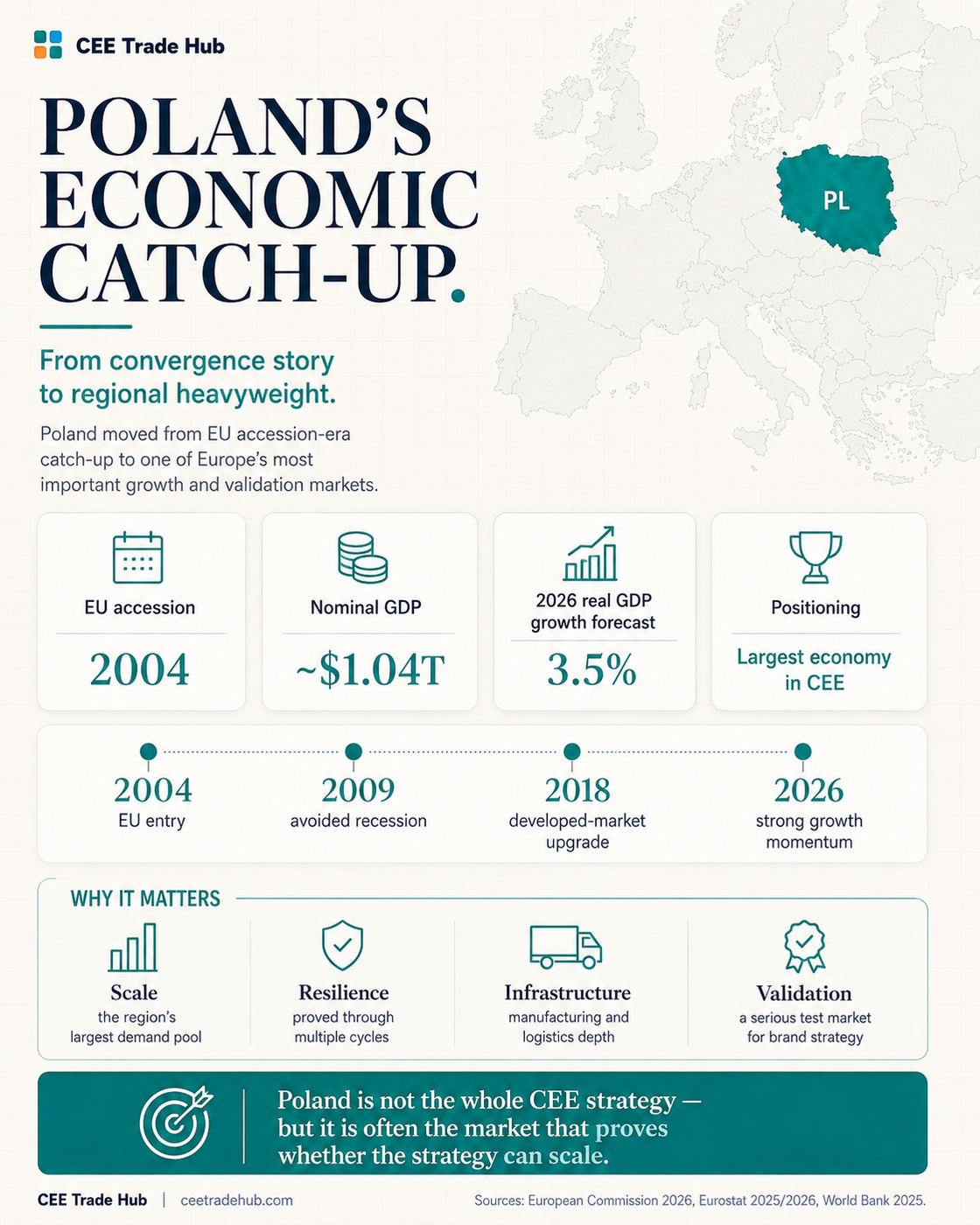
Poland joined the European Union in 2004 and has spent the following two decades closing part of the economic gap with Western Europe. The transformation is visible in infrastructure, household incomes, digital commerce, logistics and the depth of modern retail. The European Commission expects real GDP to grow by 3.5% in 2026, after 3.6% growth in 2025, supported by resilient consumption and EU-funded investment.
That macro backdrop matters commercially because it changes the kind of market Poland represents. It is no longer useful to think about Poland mainly as a lower-cost Eastern European extension of a Western strategy. For many categories it is a demanding, transparent and increasingly mature consumer market in its own right.
Why scale matters differently in Poland
Scale is useful only when it creates commercial learning. Poland does that unusually well because several channel types can matter at the same time. A brand may face large omnichannel retailers, specialist chains, marketplaces, price-comparison behaviour, direct e-commerce and distributor-led accounts in one launch.
That makes Poland harder than a simple distributor market, but also more valuable as a test. A weak price architecture becomes visible quickly. Poor localisation is exposed. Inconsistent content spreads across retailer pages. Uncontrolled marketplace sellers can create a public reference price before the brand has decided what its channel strategy should be.
For a management team, these are not only Polish problems. They are often European problems discovered early.
Four reasons Poland is strategically useful
1. Scale
Poland offers the region’s largest demand pool and a broad set of national accounts. That allows a brand to test whether a proposition can move from a few enthusiastic buyers to repeatable sell-out.
2. Validation pressure
Retailers and marketplaces make comparison easy. That forces clarity around recommended retail price, promotional logic, channel margin, content quality, service and stock. A proposition that only works when those variables remain hidden is unlikely to scale well.
3. Modern channels
Poland combines strong e-commerce with developed physical retail. For consumer electronics, home, smart home, tools and adjacent categories, the interaction between online visibility and offline credibility can be commercially decisive.
4. Transferable learning
Success in Poland does not automatically prove that the same partner or channel model will work in Czechia, Romania or the Balkans. It can, however, validate the fundamentals: product-market fit, pricing, account economics, content, stock model and the organisation’s ability to support a demanding launch.
Poland is not the whole CEE strategy
The mistake is to turn Poland’s importance into a regional shortcut. Czechia can be more concentrated and digitally efficient. Romania can offer a different scale opportunity with stronger local channel specificities. Slovakia may work as an adjacency market. Hungary and Bulgaria can require more selective partner and account prioritisation.
A strong CEE strategy therefore uses Poland as a major learning and scale market without assuming that Polish execution can simply be copied east or south.
What international brands should validate first
- Consumer price architecture: can the model support retailer and distributor economics without uncontrolled online erosion?
- Account priority: which two or three channels actually matter for the category?
- Local content: is product information good enough for comparison-heavy online shopping?
- Stock and service: can the organisation support local availability, returns and after-sales expectations?
- Governance: who owns pricing, marketplace access, promotions and partner accountability?
Commercial takeaway: Poland is not the whole CEE strategy — but it is often the market that proves whether the strategy can scale.
What a good Poland launch should produce
A successful first phase should produce more than turnover. It should leave the company with evidence: which price points convert, which retailers are credible category builders, what promotional depth is sustainable, which content claims matter to consumers, how returns and service behave, and whether the internal team can maintain discipline across channels.
Those learnings are particularly valuable because they can be separated into two groups. Some are regional principles — for example margin architecture, product hierarchy and seller governance. Others are genuinely local — buyer relationships, retail media formats, content nuance and promotional calendars. The discipline is to know which is which.
Where Poland can mislead headquarters
Poland’s scale can also create false confidence. A strong sell-in order from one distributor or one retailer can look like market validation before end-consumer demand has been proven. Likewise, marketplace sales may create volume while weakening the perceived value of the brand in strategic retail. The most useful KPI set therefore combines sell-in, sell-out, channel quality and price integrity.
That is why the first six to twelve months should be managed as a learning system. The aim is not maximum account count. It is a repeatable commercial model that can survive expansion into the next country.
What the 2026 macro picture changes
The European Commission’s Spring 2026 forecast expects Polish GDP to grow by 3.5% in 2026, after 3.6% in 2025. That is a strong pace relative to the EU average, but the commercial implication is not simply “more growth”. It is that a large, already competitive market is still expanding while EU-funded investment remains unusually important.
That makes Poland particularly useful for brands that want to test whether their European model can handle both scale and execution pressure at the same time. The opportunity is meaningful, but so is the cost of getting pricing, stock, content or channel governance wrong.
How to use Poland as a validation market
Management should treat the first phase as a controlled learning system. Choose the small number of accounts that best test the proposition, define the price architecture before distribution widens, and measure sell-out, availability and content quality alongside sell-in. The aim is not to maximise the number of listings in the first quarter. It is to build a model that can be repeated.
The best outcome is a clear answer to three questions: which products deserve scale, which channels build high-quality demand, and which parts of the operating model can be transferred to the next CEE market without copying Poland blindly.
Sources and methodology
This article combines public macroeconomic data with CEE Trade Hub editorial analysis of route-to-market and retail structure. Macro data should be refreshed before investment decisions.
How this analysis was prepared
This article is an editorial analysis based on practical market-development experience and observation of public channel structures. It does not disclose confidential employer, retailer, distributor or client information. Market conditions and listings should be rechecked before a commercial decision.

Founder of CEE Trade Hub. International sales and market-development executive with more than a decade of experience across consumer technology, smart home, retail, distribution and European markets.
LinkedIn profile →